Yesterday, February 20, 2026, the United States Supreme Court did something that sent shockwaves through trade corridors from Washington to New Delhi to the wheat fields of Punjab. In a 6-3 decision, SCOTUS essentially told President Trump: "You went too far, buddy."
The case? Learning Resources, Inc. v. Trump. The verdict? Trump's emergency tariffs, those sweeping import taxes he slapped on nearly every country under the sun, were unconstitutional. They exceeded his presidential authority under the International Emergency Economic Powers Act (IEEPA).
But here's where it gets interesting for us. Trump didn't take his ball and go home. Within hours, he pivoted, announcing a fresh 10% tariff on all imports using a different law entirely. And while he insists that India's trade deal remains "totally unaffected," the reality on the ground, especially for our farmers already protesting, tells a more complicated story.
Let's break it down, GTC style. Grab your chai, because this one connects the dots from the Supreme Court steps to the soil of Punjab.
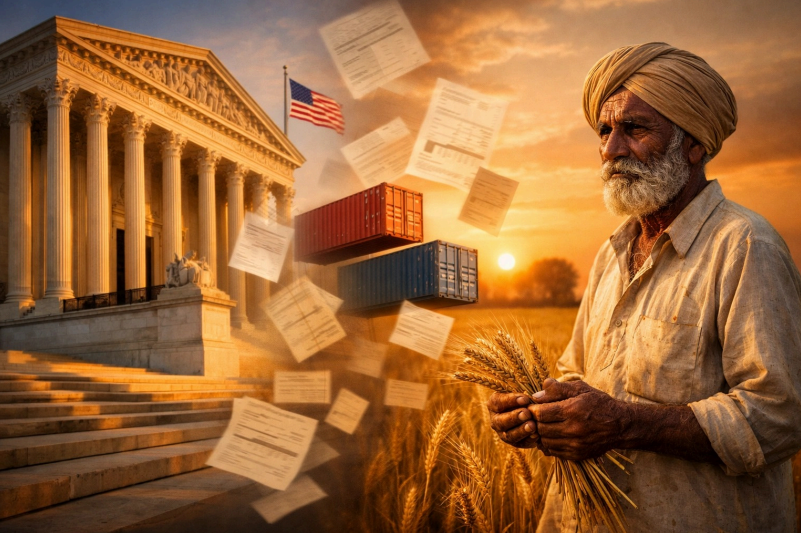
What Did the Supreme Court Actually Say?
The Supreme Court's ruling was pretty straightforward: Trump overstepped. He had used the IEEPA, a law designed for genuine national emergencies involving foreign threats, to justify his "reciprocal tariffs." These weren't your run-of-the-mill trade taxes. We're talking about a baseline 10% tariff on imports from almost every country, with even higher rates (sometimes doubling or tripling) on products from dozens of nations.
The Court's six-justice majority basically said, "Nope. Trade disputes aren't national emergencies." This was a huge check on executive power. The President can't just declare an economic emergency because he doesn't like the trade balance.
Justice Roberts, writing for the majority, emphasized that Congress, not the President, has the constitutional authority to regulate international commerce. It's Trade 101, really. But Trump had been using IEEPA as a shortcut, bypassing Congress entirely.
The immediate effect? Those IEEPA-based tariffs, worth over $200 billion collected in 2025, were vacated. Gone. Poof. At least on paper.
Trump's Lightning-Fast Pivot
Now, here's where Trump showed he's nothing if not resourceful. Literally hours after the ruling, his administration announced a replacement: a new 10% "global baseline tariff" on all imports, this time using the Trade Act of 1974.
Different law. Same outcome.
Trump was furious, calling the Supreme Court justices "unpatriotic" and claiming they were undermining American workers. But his team was already prepared with Plan B. The Trade Act of 1974 gives the President broader authority to impose tariffs for economic or national security reasons, and it has a higher legal threshold to challenge.
So while importers and trade lawyers celebrated the Supreme Court victory for about three hours, reality set in: the tariffs are back, just wearing a different legal hat.
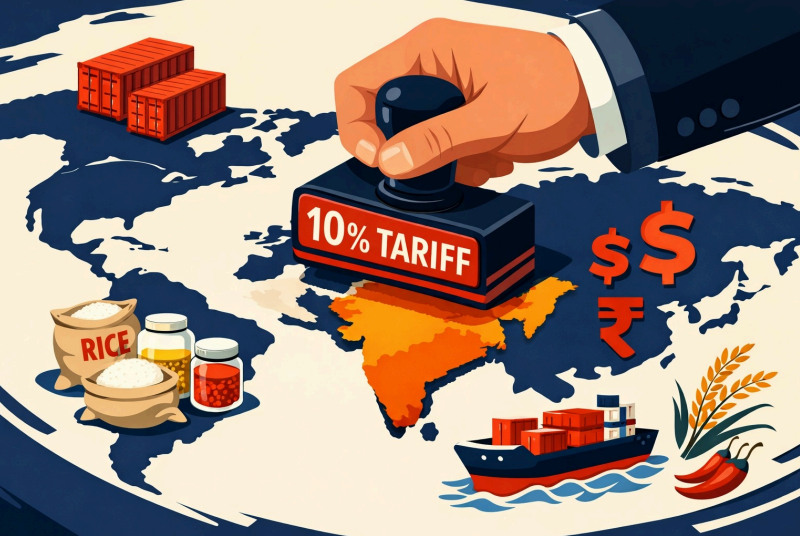
The "India Deal": What Trump Says vs. What's Actually Happening
Trump was quick to reassure India: "Our tremendous deal with India remains unaffected. We love India. Great people. Great trade."
But does it, though?
Here's the truth: While any bilateral trade agreement between the US and India might technically remain in place, the new 10% global baseline tariff applies to everyone. That includes India. That includes Indian exports, from textiles to pharmaceuticals to, yes, agricultural products.
The "India deal" Trump references might preserve certain specific provisions or tariff exemptions on particular goods. But the reality is that Indian exporters are now facing that additional 10% burden on goods heading to American shores. And in the world of international trade, even a 10% increase can make the difference between a profitable export season and a devastating loss.
For Indian businesses already dealing with supply chain disruptions, fluctuating currency rates, and domestic challenges, this is one more curveball. And the folks who feel it most? The ones working the land.
What This Means for Indian Farmers: From Fields to Fear
Let's bring this home, literally, to Punjab, Haryana, and every agricultural state across India.
Indian farmers were already in the streets. The Bharat Bandh on February 12 wasn't just about MSP (Minimum Support Price) or loan waivers. It was about economic uncertainty, fair prices, and the feeling that the entire system is stacked against the annadatas, the ones who literally feed the nation.
Now add global trade instability to the mix.
India exports significant agricultural products to the United States, rice, spices, fresh fruits, processed foods, and more. American consumers love Indian basmati rice, for instance. But when you slap a 10% tariff on those exports, here's what happens:
Scenario 1: Indian exporters absorb the cost to stay competitive. That means lower profits. Lower profits mean less money flowing back to farmers.
Scenario 2: American importers pass the cost to consumers. Indian products become more expensive. Demand drops. Orders shrink. Again, farmers feel the pinch.
Scenario 3: Both sides absorb some cost. Everyone loses a little. But in agriculture, where margins are already razor-thin, "a little" loss can devastate entire communities.
The farmers protesting in February weren't just concerned about today's prices. They were worried about tomorrow's stability. And when global trade becomes a game of legal ping-pong between presidents and Supreme Courts, that stability evaporates faster than morning dew in a Punjab summer.
The Bigger Picture: Trade Wars and the Common Man
Here's the thing about tariffs: politicians frame them as tools to protect domestic industries and workers. "Buy American!" "India First!" These sound great in speeches.
But on the ground, tariffs are taxes. They increase costs. They disrupt supply chains. They create uncertainty. And uncertainty is the enemy of farmers who need to plan planting seasons, negotiate contracts, and feed their families.
When Trump imposed his initial tariffs, the idea was to pressure other countries into better trade deals. But the Supreme Court ruling, and his immediate workaround, shows this isn't about carefully negotiated trade policy. It's about power, legal maneuvering, and political messaging.
And caught in the middle? Regular people. Farmers in Iowa worried about Chinese retaliation. Factory workers in Gujarat concerned about American market access. And yes, wheat and rice farmers in Punjab wondering if their export contracts will hold up.
Why GTC Network Is Covering This
You might be wondering: why is an entertainment and media network diving deep into Supreme Court rulings and trade policy?
Because this isn't just politics. This is real life. This affects our community: Punjabis around the world, farmers back home, families watching our channels and trying to make sense of a rapidly changing global economy.
At GTC Network, we don't just bring you the latest Punjabi films, music, and entertainment. We bring you the news that matters. The stories that connect our global audience to what's happening at home and abroad. Whether you're watching us on FreeTVPlus in California, JioTV in Mumbai, or DistroTV in Toronto, we're making sure you stay informed, stay connected, and stay empowered.
This Supreme Court ruling might seem distant: something happening in Washington D.C., far from the fields of Ludhiana or the markets of Amritsar. But global trade touches everyone. And when farmers are protesting, when trade deals shift overnight, when tariffs appear and disappear based on legal technicalities, we all need to understand what's really going on.
What Happens Next?
Legal experts expect challenges to Trump's new tariffs under the Trade Act of 1974, but that process could take months or even years. Meanwhile, the tariffs are in effect.
For India, the government will likely negotiate, push back diplomatically, and look for ways to minimize damage to key export sectors. But individual farmers? They're playing the waiting game. Hoping for stability. Hoping for fair prices. Hoping the global trade chaos doesn't destroy what's already a difficult season.
The protests in India haven't stopped. The economic concerns haven't disappeared. And now, with the US Supreme Court ruling adding another layer of uncertainty, the questions multiply: Will export orders hold? Will prices crash? Will this season be sustainable?
The Bottom Line
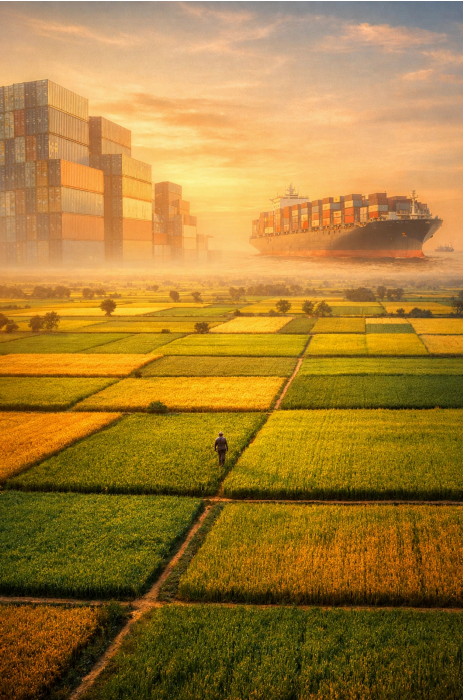
The Supreme Court told Trump he overstepped. Trump responded by finding a new legal path to the same destination. India's "safe" trade deal is safe only in the narrowest technical sense: tariffs still bite. And Indian farmers, already struggling and protesting, now face even more uncertainty in an already unpredictable global market.
This isn't just a legal story or a political story. It's a human story. It's about the people who grow our food, the families who depend on fair trade, and the communities trying to thrive in an interconnected world that sometimes feels like it's working against them.
At GTC Network, we're committed to bringing you these stories: connecting the dots between global headlines and local impact. Because when something happens in Washington, it ripples all the way to Punjab. And you deserve to know why, how, and what it means for you.
Stay tuned. Stay informed. And as always, stay connected with GTC Network: bringing the world home, one story at a time.
Want to stay updated on global news affecting our community? Follow GTC Network across all our platforms, from cable to CTV to mobile. We're covering the stories that matter, the stories that affect you, and the stories that connect our global Punjabi family. Because news isn't just about what's happening: it's about what it means for us.
Visit us at www.thegtcnetwork.com for more stories, updates, and insights. The world is watching. We're making sure you understand it.